Blog
Jan 8, 2026
The Sleep You're Missing Is Adding Up
You've adjusted to feeling tired. But your body is keeping a running tab, and it's not as easy to pay off as you think.

You stayed up late to finish a project. Woke up early for a flight. Had a rough night with a sick kid. Each time, you told yourself you'd catch up later.
But sleep doesn't work like a savings account. You can't deposit extra hours on the weekend and withdraw them during the week. Every hour you miss accumulates into what researchers call sleep debt: the gap between the sleep your body needs and the sleep it actually gets.
And here's the uncomfortable truth: you've probably adjusted to the deficit without realizing it.
Sleep debt accumulates faster than you think
The math is simple but unforgiving. If you need eight hours and consistently get seven, you're accumulating one hour of debt per night. That's five hours by Friday. Seven hours by Sunday. After a month, you're carrying the equivalent of four full nights of missed sleep.
More than one-third of American adults aren't getting the recommended seven hours per night. The most common reasons are familiar: work hours, commuting, socializing, screen time. Small compromises that don't feel significant in the moment but compound over time.
Going to bed 30 or 60 minutes late doesn't feel like a big deal. But do it for a week and you've built up hours of debt. Do it for months and you're operating in a fundamentally different state than you realize.
The dangerous part: you stop noticing
Here's what makes sleep debt particularly insidious: research shows that people cognitively adapt to chronic sleep restriction without feeling proportionally sleepy. Your subjective sense of tiredness levels off, but your actual performance continues to decline.
In a landmark study by Van Dongen and colleagues, participants who slept six hours per night for two weeks showed cognitive impairment equivalent to someone who had stayed awake for 24 hours straight. But their subjective sleepiness plateaued after about a week: they stopped feeling more tired even as their performance kept deteriorating.
This creates a dangerous blind spot. You feel like you've adapted. You've gotten used to running on less. Meanwhile, your reaction time, decision-making, memory consolidation, and emotional regulation are all degraded in ways you can't perceive from the inside.
Research confirms that people can develop chronic sleep debt while having a "false sense of recovery" after sleeping in on weekends. The short-term restoration of one good night's sleep, combined with the natural alertness of your circadian rhythm during the afternoon, can mask the accumulated deficit. You feel fine for a few hours. But the debt remains.
Weekend catch-up doesn't erase the damage
The intuitive solution is to sleep more when you can. Bank extra hours on Saturday and Sunday. Let yourself wake up naturally.
It helps, but not as much as you'd hope.
Studies have found that sleeping in on weekends does not reverse the metabolic dysregulation associated with chronic sleep loss. The hormonal disruption, the insulin sensitivity changes, the inflammatory markers: these don't simply reset because you slept until noon.
One experiment restricted participants to five hours of sleep per night during the workweek, then allowed unlimited catch-up sleep on weekends, then returned them to five-hour nights. Half the participants still showed biological markers of sleep deprivation on their very first day back to restricted sleep. The weekend recovery didn't stick.
Research suggests it can take up to four days to recover from just one hour of lost sleep, and up to nine days to fully eliminate accumulated sleep debt. That's a recovery timeline most people's schedules don't accommodate.
The compounding costs
Sleep debt doesn't just make you tired. It affects nearly every system in your body.
Cognitive function: Chronic partial sleep deprivation produces cumulative deficits in alertness, vigilance, and psychomotor performance. These deficits continue to worsen with each additional day of insufficient sleep, without any sign of stabilizing.
Emotional regulation: Sleep debt amplifies amygdala reactivity, making you more sensitive to negative stimuli. Research shows that resolving sleep debt through extended sleep improves mood regulation by restoring the connection between the amygdala and prefrontal cortex.
Metabolic health: Insufficient sleep disrupts hormones that regulate appetite (ghrelin and leptin), increases cortisol, and impairs insulin sensitivity. Studies link chronic sleep debt to elevated body mass index and increased risk of type 2 diabetes.
Immune function: Sleep restriction weakens your body's ability to fight infections. The longer you carry sleep debt, the more vulnerable you become.
Long-term risk: Chronic sleep deprivation has been associated with increased risk of cardiovascular disease, hypertension, and even neurodegenerative conditions. Research suggests that sleep acts as a brain-cleaning process, flushing out toxic proteins like beta-amyloid. When you consistently under-sleep, these toxins accumulate.
Why recovery is harder than you expect
If you've been running a sleep deficit for weeks or months, you can't fix it in a weekend. Studies examining six weeks of chronic sleep restriction found that two weekend nights of recovery sleep were insufficient to restore cognitive performance. Deficits in spatial orientation and vigilant attention persisted throughout the study.
Another study restricted sleep for seven days, then provided three recovery nights with eight hours of sleep opportunity. Performance on attention tasks decreased steadily during restriction, then remained at that lower level throughout recovery. It didn't bounce back.
The dynamics of recovery are different from the dynamics of accumulation. Sleep debt builds gradually, almost imperceptibly. Paying it back requires sustained, consistent sleep over days or weeks, not one or two good nights.
What actually works
The best strategy is prevention: don't accumulate significant debt in the first place. But if you're already carrying a deficit, here's what the research suggests.
Extend sleep consistently, not just on weekends. Adding 30 to 60 minutes per night over several weeks is more effective than dramatic weekend sleep-ins. Your body

What Is Social Jet Lag?
Why weekend sleep shifts can make Monday feel harder.

What Your Flagged Vitals Mean
Heart rate elevated. Temperature flagged. Here's what your body is actually telling you.
4.7 1.100+ Reviews
See how much sleep you actually owe
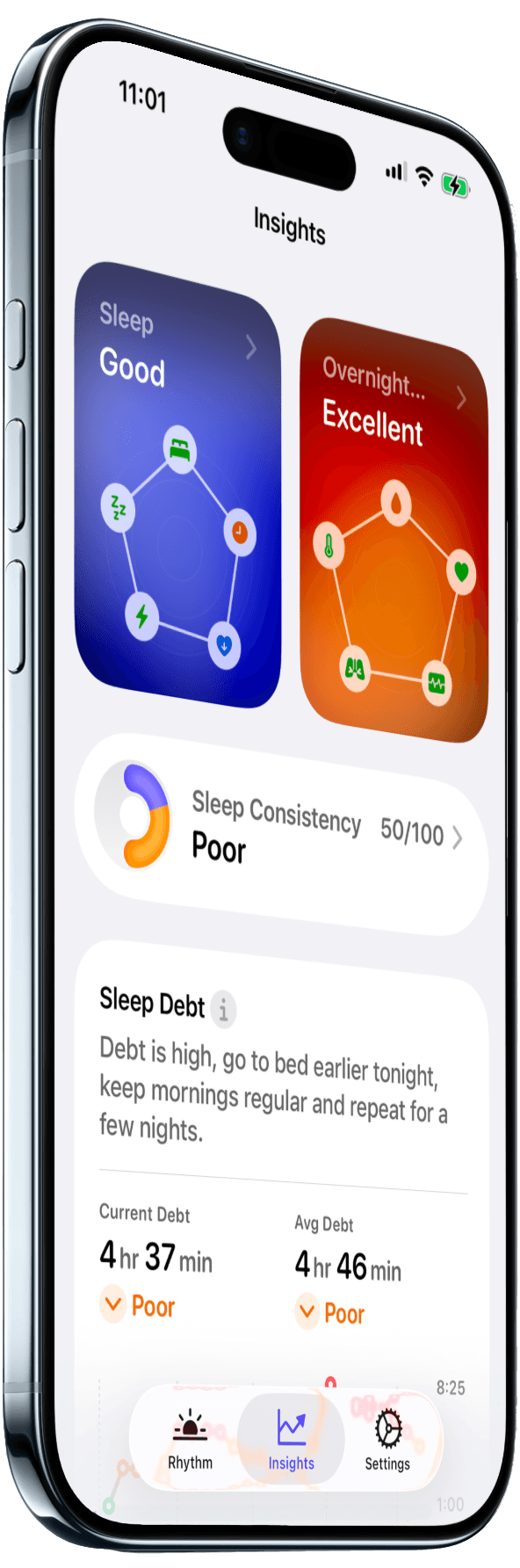
Peaks tracks your accumulated sleep debt over time, so you know when you're running a deficit.