Blog
Jan 8, 2026
Why Your Weekend Sleep Schedule Might Be Hurting You
Sleeping in on Saturday feels like a reward. But the science says your body pays a price every time your schedule shifts.

You've had a long week. Friday night arrives, and you stay up late. Saturday morning, you sleep in. By Sunday evening, you're dreading Monday's alarm.
This pattern is so common it has a name: social jetlag. And research suggests it may be doing more damage than you realize.
What is social jetlag?
Social jetlag describes the mismatch between your body's internal clock and the schedule your life demands. It's the gap between when you naturally want to sleep and when you actually do.
The term was coined by researchers who noticed that shifting sleep times between weekdays and weekends produces effects similar to crossing time zones. The difference is that travel jetlag eventually resolves once you adjust to the new time zone. Social jetlag happens every single week.
Studies estimate that up to 70% of the population experiences some degree of social jetlag. For many people, it's a two-hour shift or more between their weekday and weekend sleep midpoints.
The hidden cost of inconsistency
Here's what makes this concerning: a major study analyzing over 60,000 participants found that sleep regularity is a stronger predictor of mortality risk than sleep duration.
That's worth repeating. How consistently you sleep matters more for longevity than how long you sleep.
Participants in the top 20% for sleep regularity had a 20-48% lower risk of all-cause mortality compared to those in the bottom 20% with the most erratic patterns. The protective effect held even after accounting for other health factors.
The same study found significant risk reductions for specific causes of death: roughly 57% lower risk for cardiovascular disease, 39% for cancer, and 61% for other causes among those with the most regular sleep patterns.
Why regularity matters so much
Your body doesn't just track how much sleep you get. It anticipates when sleep will happen.
Your circadian rhythm orchestrates hundreds of biological processes: hormone release, body temperature, digestion, immune function. These systems prepare for sleep hours before you actually go to bed. When your schedule is consistent, everything aligns. When it shifts, your biology scrambles to catch up.
Research shows that late chronotypes (people who naturally prefer staying up late) are 2.5 times more likely to report poor health than early chronotypes. They also have elevated rates of type 2 diabetes, obesity, and metabolic syndrome. Part of this is because night owls face the largest mismatch between their biology and typical work schedules, creating more severe social jetlag.
The metabolic effects are particularly striking. Studies have found that the odds of metabolic syndrome increase by about 30% for each additional hour of weekend "oversleep" compared to weekdays.
The sleep consistency paradox
This creates an uncomfortable tension. If you've accumulated sleep debt during the week, shouldn't you catch up on weekends?
The National Sleep Foundation's consensus panel addressed this directly. Their conclusion: yes, when you've built up significant sleep debt, extending sleep on non-work days (by one to two hours) can be beneficial. But this should be a backup strategy, not a weekly habit.
The ideal approach is to minimize the debt in the first place by keeping a more consistent schedule throughout the week. When that's not possible, modest catch-up sleep is better than carrying the debt forward. But large swings in your schedule (staying up three hours later, sleeping in three hours later) come with their own costs.
A systematic review of 41 studies involving over 92,000 participants found that both later sleep timing and greater sleep variability were associated with worse health outcomes across the board: cardiovascular health, metabolic health, mental health, and cognitive performance.
What counts as "consistent"?
Perfect consistency isn't realistic for most people. But there's a meaningful threshold.
Sleep researchers suggest keeping your weekend-to-weekday sleep offset within 30-50 minutes to minimize health impacts. Once you exceed an hour of difference, the risks start climbing.
Think of it this way: a modest shift is like adjusting to a neighboring time zone. A two-hour shift is like flying from New York to Denver every Friday and back every Monday. Your body notices.
Practical steps toward consistency
The goal isn't perfection. It's reducing the magnitude of the weekly swing.
Anchor your wake time. Your wake time has more influence on your circadian rhythm than your bedtime. Even if you go to bed late, waking up within an hour of your usual time helps maintain alignment. It's counterintuitive, but a consistent wake time with some variation in bedtime is better than wild swings in both directions.
Use light strategically. Morning sunlight is the strongest signal for resetting your internal clock. Research shows that just 15 minutes of morning light can help regulate your body clock and make it easier to fall asleep at a consistent time that night.
Shift gradually. If your schedule is currently irregular, don't try to fix it overnight. Adjust your bedtime and wake time by 15-30 minutes every few days until you reach your target.
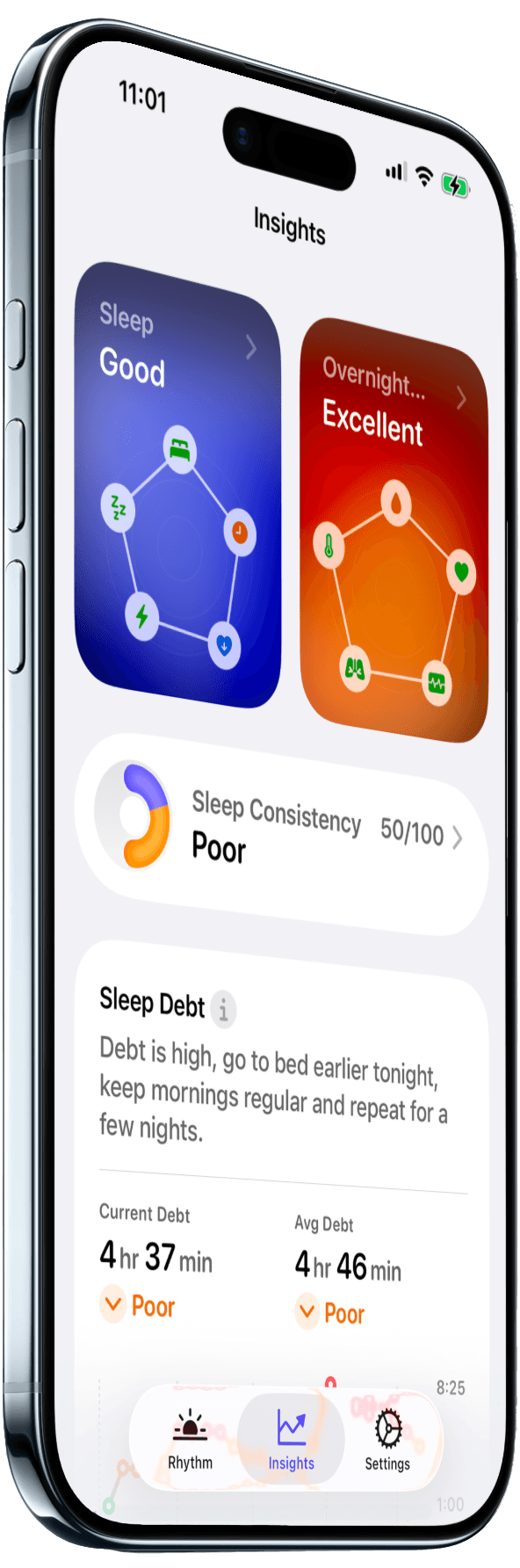
Track the pattern, not just the night. A single late night isn't the problem. It's the accumulated pattern over weeks and months. Seeing your consistency score over time makes it easier to spot when you're drifting and correct before the effects compound.
The bottom line
Sleep duration gets most of the attention. But the evidence increasingly points to consistency as the factor that matters most for long-term health.
You can't always control how much sleep you get on a given night. But you have more control over when you sleep than you might think. Keeping that schedule steady, even roughly, may be one of the simplest things you can do for your health.
What Is Social Jet Lag?
Why weekend sleep shifts can make Monday feel harder.

What Your Flagged Vitals Mean
Heart rate elevated. Temperature flagged. Here's what your body is actually telling you.
4.7 1.100+ Reviews
Track your sleep consistency over time
Peaks shows you how regular your patterns are, not just how long you slept.